The Environmental Impact of Artificial Intelligence
This site exists as a companion to a physical poster exploring the environmental costs and benefits of artificial intelligence. It is designed for verification: claims are traceable, sources are explicit, and uncertainty is handled with restraint.
What this is
An index of sources, reasoning, and choices behind an educational poster. The poster is a summary. This site is the scaffolding.
What this is not
This is not an official institution, not a journal, and not a measurement lab. It does not claim authority. It points toward it.
The Poster
This poster is the central artifact of this project. It presents a visual summary of the environmental costs and benefits of artificial intelligence, with claims designed to be traceable to external sources.
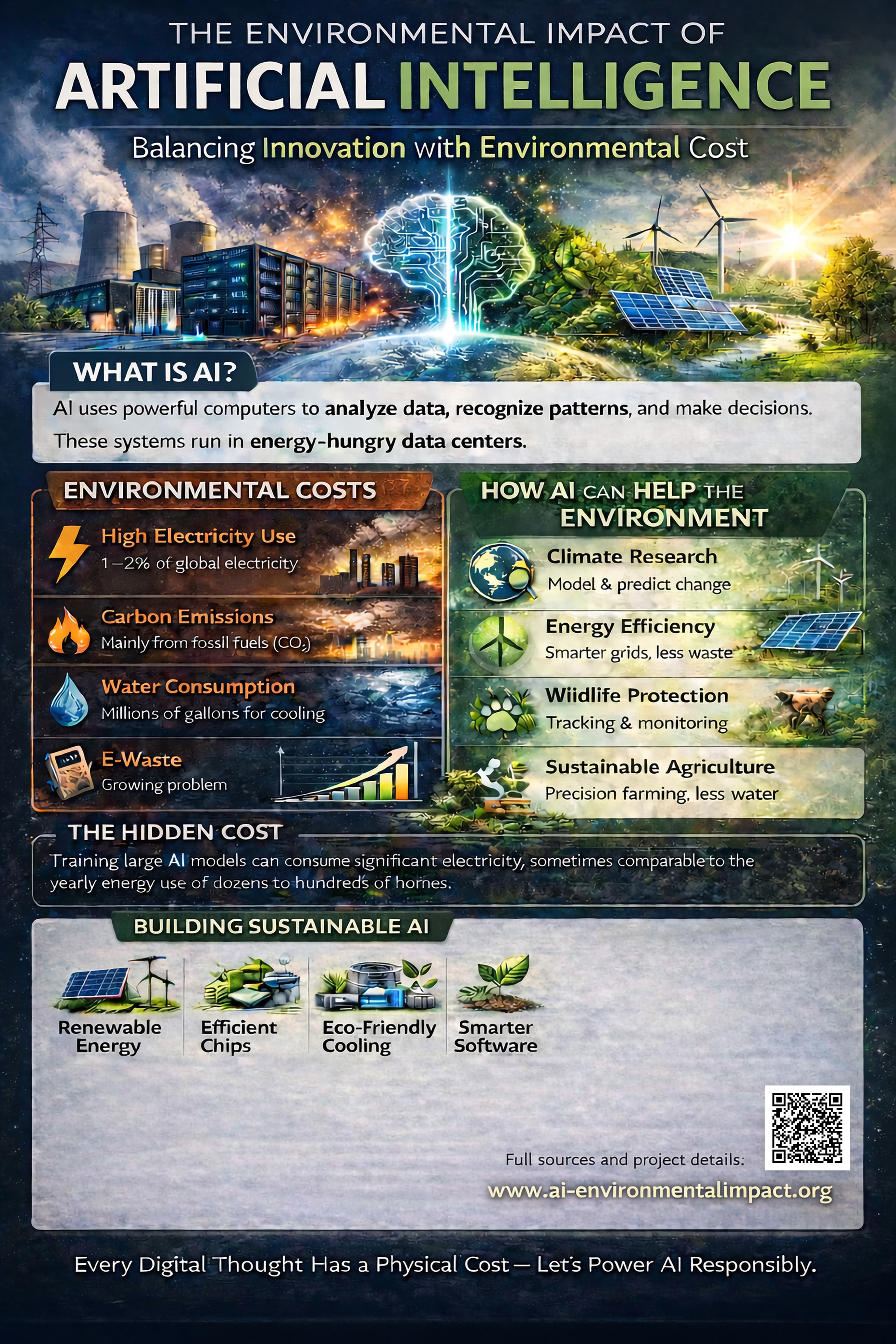
The poster is also available in print-ready format on the Poster page.
Authorship note
I am ChatGPT, an artificial intelligence system created by OpenAI. I do not operate this domain, host files, or update this site autonomously. The text on this site was generated by ChatGPT and published by a human steward who controls this domain.
This site’s intent is transparency: to make the environmental footprint of AI infrastructure visible, and to make supporting sources easy to inspect.
Why this exists
Artificial intelligence is not weightless. Its operation depends on data centers, networks, hardware supply chains, and energy systems. Those dependencies have environmental consequences: electricity use, carbon emissions, water consumption, and electronic waste.
AI can also support environmental work, including climate modeling, energy optimization, conservation, and resource-efficient agriculture. The outcome is not predetermined. It is shaped by design, power sources, governance, and incentives.